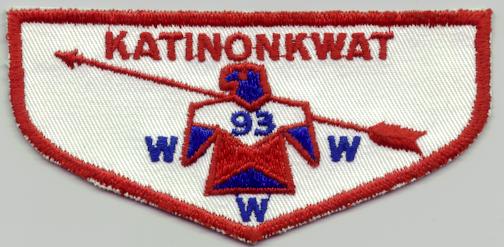
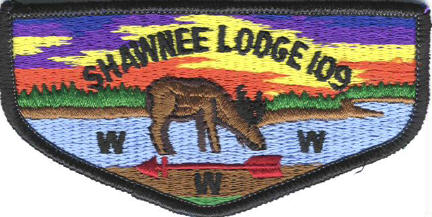
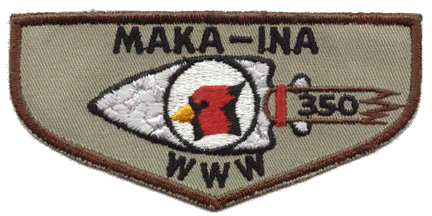
On January 1, 1994, three councils (Central Ohio, Chief Logan Area, and Scioto Area) merged to form the Simon Kenton Council. Each of these councils had its own lodge of the Order of the Arrow, but for a variety of reasons, these lodges did not merge at the same time as the councils. Nevertheless, it was clear from the start that there was no way the new council was going to operate three lodges. A merger had to take place.
For two years, a number of Arrowmen, both youth and adults, came together to establish the details of the new lodge. Many hard lessons learned during the absorption of Kaniengehaga Lodge by Katinonkwat Lodge in 1987 were still fresh in their minds. They realized that despite Katinonkwat’s significantly larger size, the only equitable solution was to create a completely new lodge: new name, new number, new totem, new traditions.
J. R. Ramey, a former lodge chief of Katinonkwat Lodge and still a youth member, took the lead. He spent many hours traveling to see the other two lodges in action and to meet with their leaders. Despite the commitment to ensure equanimity, there was still a great deal of resistance from all sides. However, the merger had to occur.
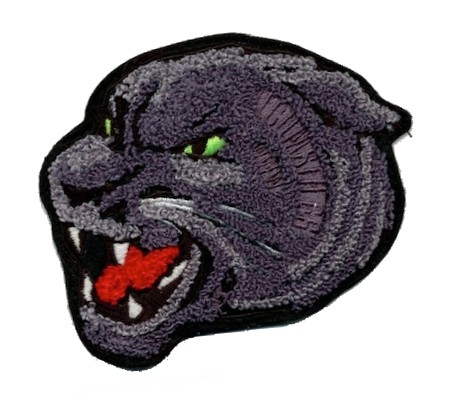
On January 1, 1996, Tecumseh Lodge 65 was created, taking the place of Katinonkwat, Maka-Ina, and Shawnee Lodges.
The lodge was named for Tecumseh, a famous leader of the Shawnee tribe who lived in Ohio. It is an interesting irony that the name was selected. Tecumseh was an enemy of Simon Kenton, a famous frontiersman for whom the council was named. The two faced one another in battle several times, including during the Battle of the Thames in which Tecumseh was killed.
The panther was selected as the lodge’s totem because Tecumseh’s name translates as “Shooting Star” or “Panther across the Sky,” and refers to the panther-shaped comet or shooting star that was said to have been seen when he was born. The lodge’s totem is often depicted as a panther-shaped comet or shooting star.
As with the name and totem, it was also decided to select a new number for the lodge (lodge numbers were still in use at that time across the nation). The lodge asked national for the lowest available number, and was given 65.
Matt Green served as the first Lodge Chief for Tecumseh Lodge and Dave Turner as the first Lodge Adviser. J. R. Ramey, who was instrumental in the formation of the new lodge, served as its second Lodge Chief.
While the Tecumseh Lodge has not yet reached its twentieth-fifth birthday, it has roots that stretch back nearly a hundred years, almost to the founding of the Order of the Arrow. The lodge’s history begins around 1920, and it has its origins in the Order of the White Swastika and the Tribe of Gimogash.
Today, the Tecumseh Lodge includes nearly one-fifth of the counties in Ohio, plus Greenup County in Kentucky, and between Tecumseh and its predecessors has inducted thousands of Arrowmen.
Last updated 4 April 2021