Order of the White Swastika
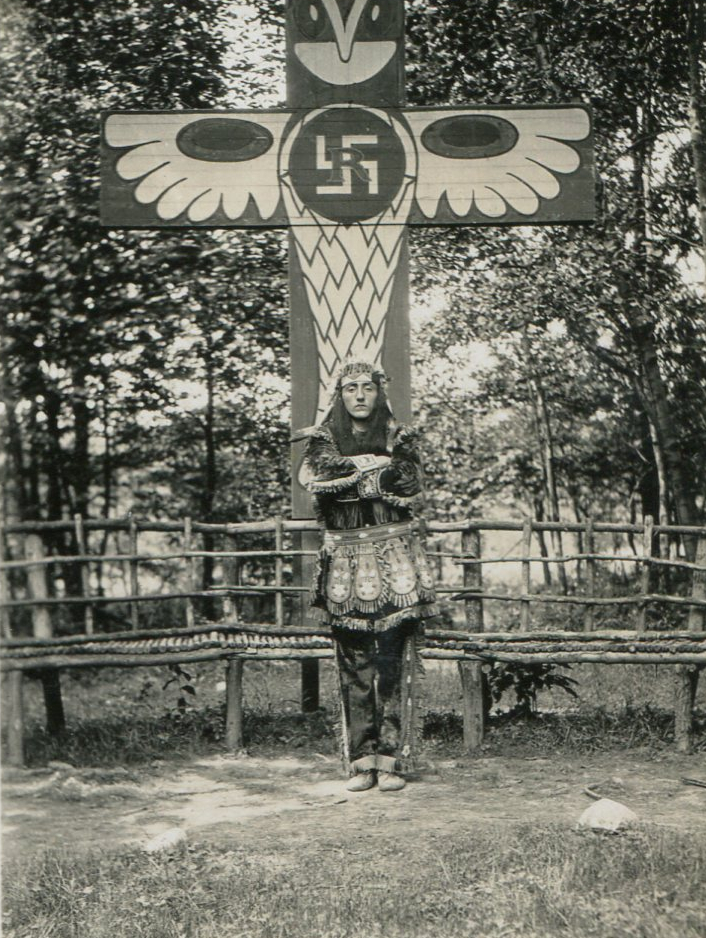
While the Order of the Arrow was one of the first honor camper societies, it was certainly not the only one. There were dozens of known societies that were created at one camp and spread to others. One of these was the Order of the White Swastika.
The Order of the White Swastika (sometimes called the Mystic Order of the White Swastika) was known to have existed at a few different camps, including Camp Oyo in the Scioto Area Council, and Camp Burroughs and Camp Lazarus in the Columbus Council, both of which now form part of the Simon Kenton Council.
The Order of the White Swastika was established at Camp Burroughs during the 1921 or 1922 camping season, and is thought to have continued there until the camp closed in 1929. Sometime in the mid-1920s the society spread to Camp Oyo as well, though the exact year is not currently known.
In 1925, Columbus Council opened Camp Lazarus (then called Ro-Fre-La, in honor of Rose and Fred Lazarus). It appears that new inductions at Camp Lazarus may have ended in the early 1930s, but this is not certain. Still, the fraternity was not completely forgotten.
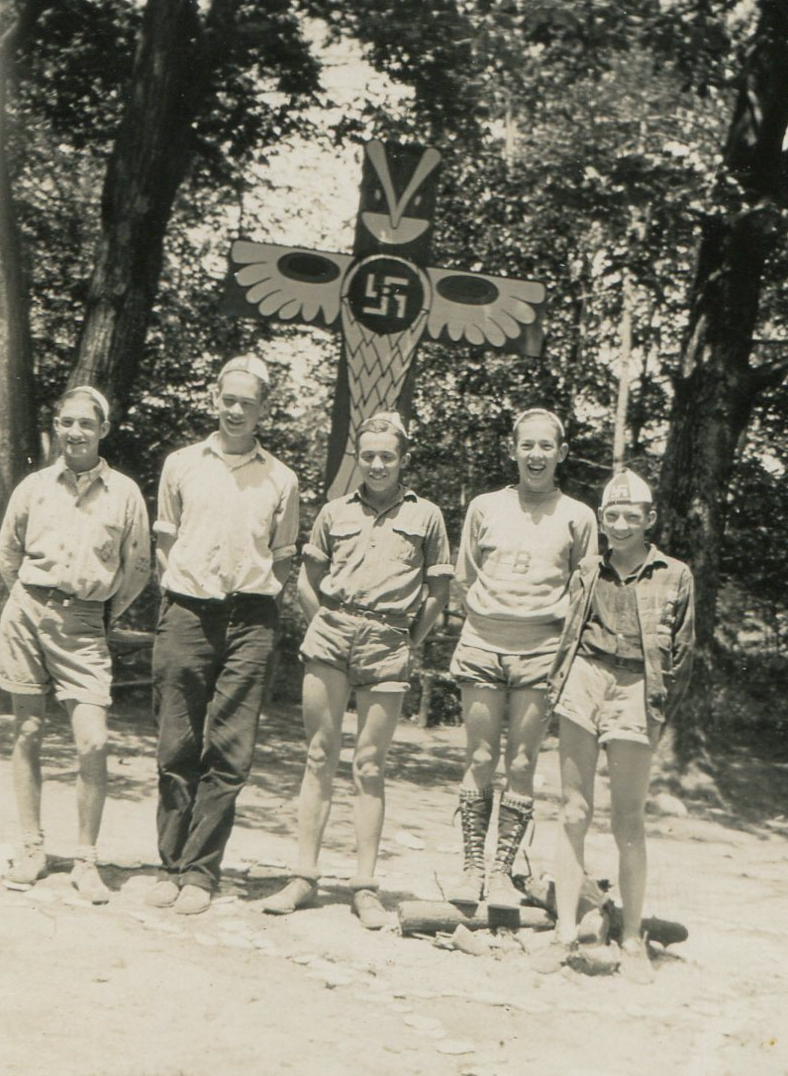
In the 1930s, the swastika was established as the symbol of the National Socialist (Nazi) party in Germany, creating negative associations with the symbol that resulted in every camp using the program to rethink it. In 1936, the remaining members of the Order of the White Swastika who had been inducted at Camp Burroughs and Camp Lazarus held a reunion at Camp Lazarus. On July 24, 1936, they were inducted into the Order of the Arrow as charter members of Katinonkwat Lodge, followed immediately by the first induction of new members from that summer’s campers.
The thunderbird, which was used as a totem for the White Swastika at Camp Lazarus, was also chosen as the totem for the newly formed Katinonkwat Lodge. Members of the Order of the White Swastika were identified by a felt white swastika patch, usually bearing something in its center to identify the camp (a B for Camp Burroughs, an R for Ro-Fre-La, and an O for Camp Oyo are known examples; Camp Oyo at some point also used a round Indian head in place of the O). There are pictures of scouts wearing a camp beanie with the swastika on it as well.
In a similar fashion, the Order of the Arrow replaced the Order of the White Swastika at Camp Oyo in July, 1938, when the Shawnee Lodge was established.
.jpg)
One of the camps best known for its White Swastika group is Camp Russell in New York, but the organization definitely did not originate there. In fact, the Order did not arrive at Camp Russell until the 1930s, at least ten years after it was in use at Camp Burroughs. There is no known connection between the camps and it may be pure coincidence that the same name was used for both groups.
In order to become a member of the Order, scouts had to participate in a wide range of camp activities that demonstrated their physical, moral, and social aptitudes, including service to the camp, as well as earn rank advancement or merit badges.
In addition to the membership requirements, there were also requirements to advance to a second degree in the White Swastika, called the Good Indian. These included earning additional merit badges, as well as planning and carrying out a permanent camp improvement project.